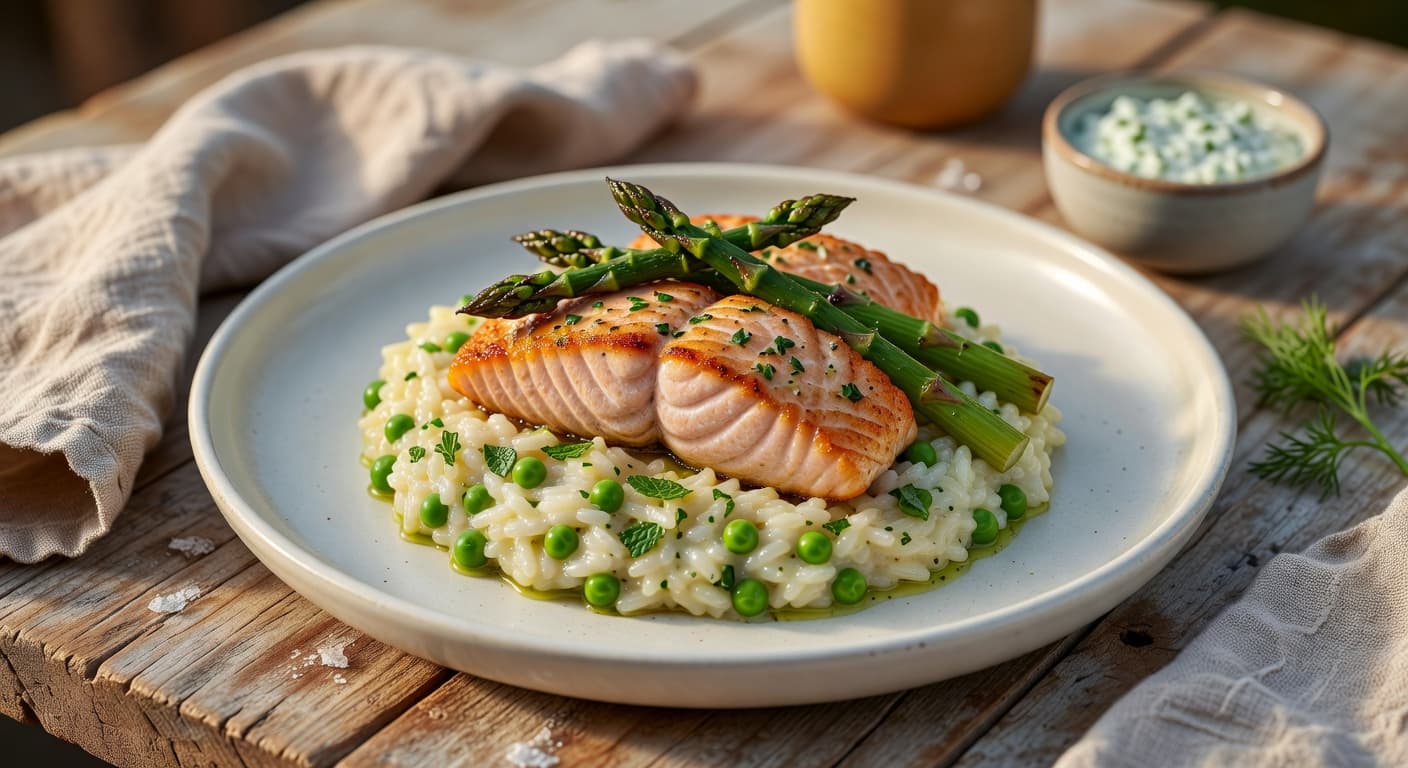
Spring on a Plate: Pan-Seared Salmon with Pea-Mint Risotto & Charred Asparagus
Crispy-skinned salmon, creamy pea-mint risotto, and lightly charred asparagus — this is the kind of dinner that feels restaurant-worthy but comes together on a weeknight stovetop in under an hour.
 Dan Cooks8 min readPrint this post
The best meals aren't measured by perfection — they're measured by the memories made around the table.
Now, I'm a grill man through and through — you know that. But every now and then, even I put down the tongs and step inside to the stovetop. And when I do, I want something that earns that move. This lemon-herb salmon with pea-mint risotto is exactly that dish. It's the kind of plate that makes my wife's eyes light up the moment it hits the table — bright, fresh, and just a little bit fancy without any of the fuss. Born Southern, I've always believed that good food doesn't need to be complicated. It needs to be honest. Real ingredients, treated right, seasoned with soul. That's what this is. Creamy arborio risotto folded with sweet peas and fresh mint, a squeeze of lemon running through the whole thing, and salmon seared hard enough to get that golden, crackling skin. It's spring in a bowl, and it's ready in under an hour.
Two Things That Make or Break This Dish
My grandmother Hellon used to say that the difference between a good cook and a great one is patience. She wasn't talking about hours in the kitchen — she was talking about those two or three moments in a recipe where you just have to slow down and do it right. This dish has exactly two of those moments. First: the salmon. You salt it early, let the salt work its way in, and then — and this is the part most folks skip — you pat it completely dry before it ever sees the pan. That dry surface is everything. It's what gives you that clean, golden sear instead of a pale, steamed fillet. Second: the risotto. You add the broth one ladle at a time, stirring and waiting, stirring and waiting. It's not hard work, but it is deliberate work. And that patience is exactly what coaxes the starch out of the arborio and turns it into something silky and rich. Get those two things right, and the mint, the lemon, the asparagus — they all just fall into place.
Three moves make or break this recipe.
Three moves that separate a good version of this dish from a great one. Don't skip any of them.
Add warm broth one ladle at a time; each addition should absorb in roughly 2 minutes. Total risotto cook time is 18–22 minutes from the first ladle. Salmon needs 3–4 minutes skin-side down over medium-high, then 1–2 minutes on the flesh side.
- Dry-brine salmon skin-side up on a rack for at least 15 minutes, pat completely dry before searing
- Sweat shallot and garlic in olive oil until translucent before adding rice — don't rush this step
- Deglaze with white wine and let it absorb fully before adding any broth; that acid needs to cook in
Here's the science behind why dry-brining your salmon matters — and why that final pat-dry step is non-negotiable.
Salt-firming fish proteins
Salt draws moisture out of salmon via osmosis, then firms and seasons the flesh. The result is a fillet that sears cleanly and holds together on the plate.
Pat dry after brining — surface moisture is the enemy of a good sear.
The Salmon: Respect the Sear
Season your salmon fillets generously on both sides and let them sit uncovered for at least 15 minutes — 30 is even better. During that time, salt is drawing moisture to the surface and then pulling it back in, seasoning the flesh all the way through and firming it up. Right before the fish goes in the pan, pat it completely dry with paper towels. Any moisture left on the surface will steam the fillet instead of searing it, and you'll lose that crispy skin entirely. Get your cast iron ripping hot, add a tablespoon of olive oil until it shimmers, then lay the salmon skin-side down. Press it gently for the first 30 seconds — this keeps the skin flat against the pan and stops it from curling up. Then leave it alone. Four to five minutes undisturbed, until the skin is deeply golden. One flip, two to three more minutes on the flesh side, and you're done. Let it rest while you finish the risotto.
45 minutes, and you’re ready to cook.
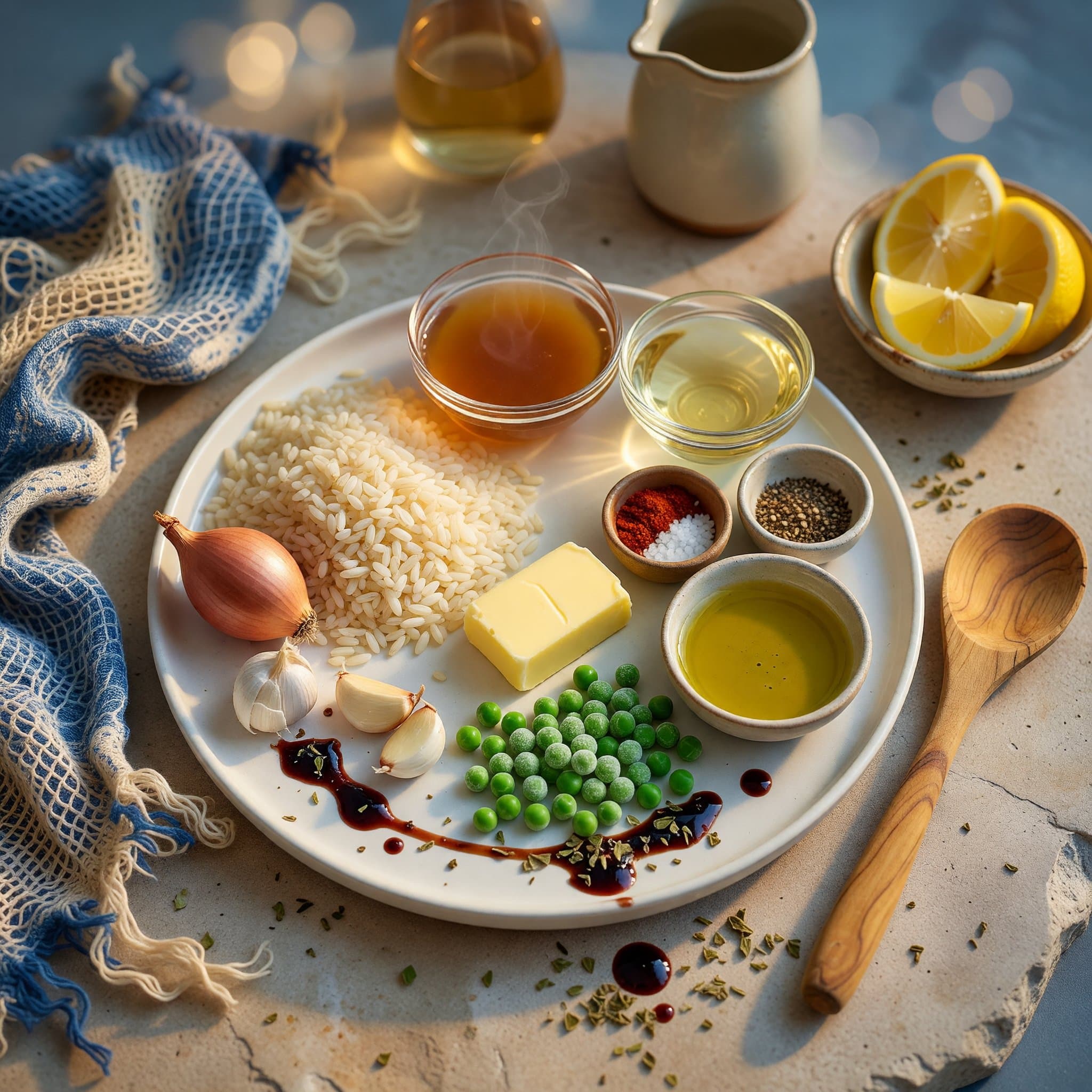
Everything you need to have ready before the first burner goes on. Good mise en place is what makes this a relaxed weeknight dinner instead of a stressful one.
- Gather EquipmentGather all equipment: small saucepan, wide skillet or Dutch oven, cast iron skillet or grill pan, cutting board, chef's knife, wooden spoon, ladle, paper towels, box grater, small bowls for prepped ingredients, measuring cups and spoons.
- Prepare the ShallotsPeel the shallots, removing the papery skin. Slice them in half lengthwise, then thinly slice crosswise into half-moons. You'll need about 2 shallots, finely sliced. Place in a small prep bowl.3 min
- Prepare the GarlicPeel 2 cloves of garlic and mince finely. Place in a small prep bowl.2 min
- Measure the Arborio RiceMeasure out ¾ cup Arborio rice into a small bowl. Do not rinse.1 min
- Measure the Dry White WineMeasure out ¼ cup dry white wine into a small bowl or measuring cup.30s
- Prepare the LemonZest the lemon using a microplane or fine grater to yield about 1 teaspoon zest. Cut the lemon in half and set aside for juicing during cooking. Place zest in a small bowl.2 min
- Chop the Fresh MintRinse fresh mint and pat dry. Roughly chop the leaves to yield about 3 tablespoons. Place in a small bowl.2 min
- Grate the Parmesan CheeseGrate Parmesan cheese on the fine side of a box grater to yield ¼ cup. Place in a small bowl.2 min
- Measure Spices for RisottoMeasure out ½ teaspoon kosher salt and ¼ teaspoon black pepper for the risotto. Combine in a small bowl.1 min
- Prepare the Salmon FilletsPat the 2 salmon fillets very dry with paper towels. Season both sides generously with ½ teaspoon kosher salt and ¼ teaspoon black pepper. Place on a plate.3 min
- Prepare the AsparagusRinse the asparagus and trim the woody ends by snapping them off at the natural break point (about 1–2 inches from the bottom). Pat dry with paper towels. Place in a bowl and set aside.3 min
- Measure Butter and Olive OilMeasure out 2 tablespoons butter for the risotto base, 1 tablespoon olive oil for the risotto, 1 tablespoon olive oil for the salmon, and 1 tablespoon olive oil for the asparagus. Place each in a small bowl or measuring cup, labeled if needed.1 min
- Measure Frozen Peas and Chicken BrothMeasure out ½ cup frozen peas into a small bowl. Pour 3 cups chicken broth into a measuring cup.2 min
- Stage IngredientsArrange all prepped ingredients near the stove in cooking order: shallots and garlic together, rice, white wine, chicken broth (in its saucepan), peas, Parmesan, lemon zest and lemon halves, mint, risotto spice blend, seasoned salmon fillets, asparagus, and the three portions of olive oil. Have paper towels and a ladle within reach.
- arborio rice + peasBoth carry fresh, grassy, earthy and roasted notes.
- garlic + olive oilBoth carry piney, citrusy, clove-like and smoky notes.
- garlic + black pepperBoth carry piney, citrusy, earthy and roasted notes.
Mint & Lemon: Why This Pairing Sings
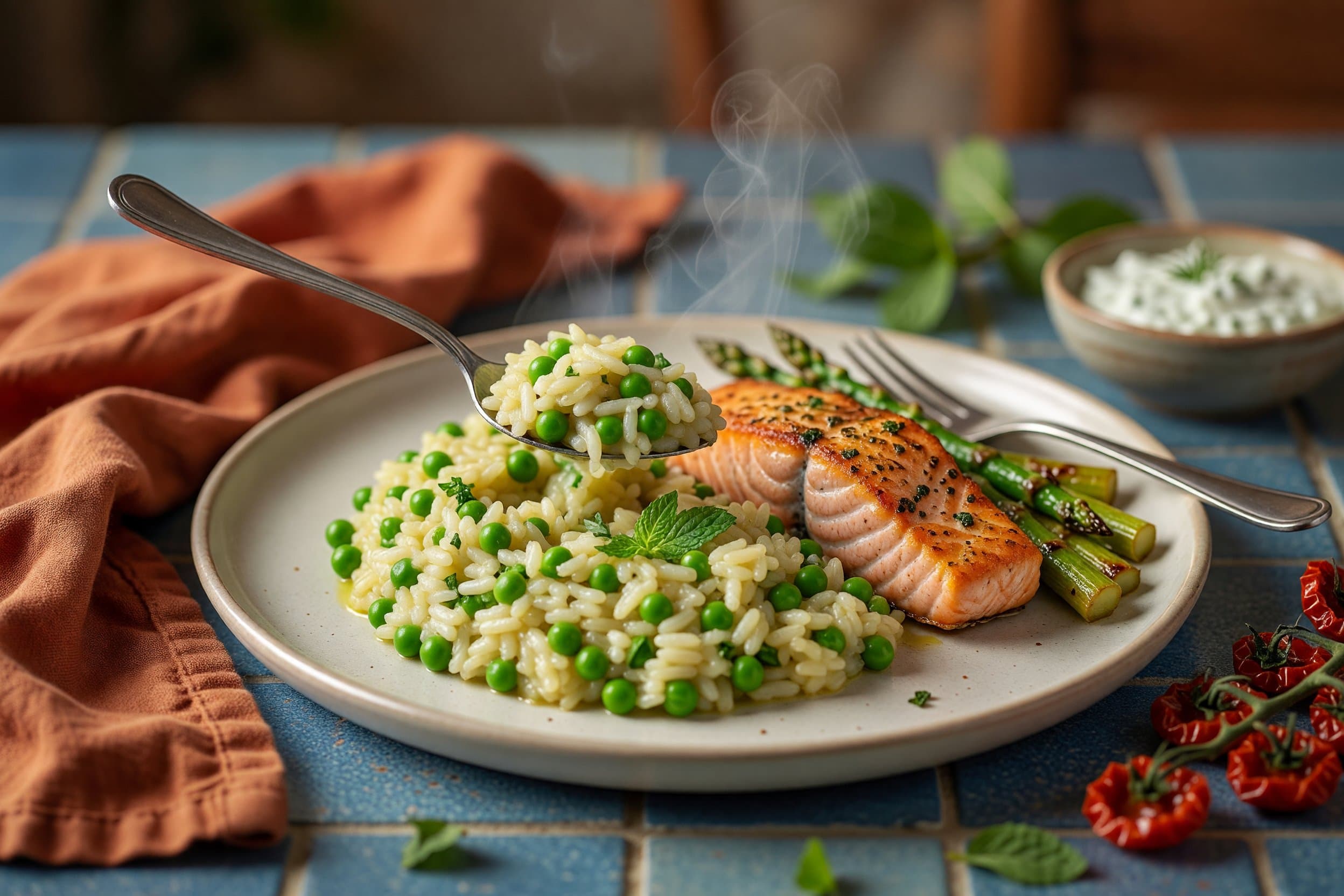
Mint and lemon is one of those combinations that just feels right — and there's a real reason for it. These two share a common aromatic character, a fresh, bright, green-citrus quality where each one makes the other more vivid rather than competing with it. That's why the risotto tastes so clean and intentional: the mint and lemon aren't fighting for attention, they're reinforcing each other. The key is timing. Fold the mint into the risotto off the heat so that brightness stays alive in the finished dish. Then hit the bowl with lemon zest right before serving to layer that citrus note on top. Same principle applies to the asparagus — a drizzle of olive oil and a squeeze of lemon after it comes off the pan ties it right into the rest of the plate.
Mint is the quiet hero of this dish. Here's what it pairs with best across the whole plate.
MintLemon
Score 88Both carry piney notes.
PeasMint
Score 82Olive OilMint
Score 72Both carry piney notes.
Where to Source Your Key Ingredients
For the salmon, look for center-cut fillets of even thickness. Tail pieces are thinner on one end and thicker on the other, which means part of the fillet overcooks before the rest is done. Even thickness gives you an even sear and an even cook every time. Wild-caught sockeye or king salmon are both excellent here — richer flavor and that deep orange color that looks stunning against the green risotto. For the rice, Arborio is your standard and it works perfectly. If your store carries Carnaroli, grab that instead — it holds its shape a little better and gives you a slightly firmer bite, which some folks prefer. Fresh mint makes a real difference over dried here; dried mint just doesn't have the same lift. Buy a small bunch and use what you need.
- Contains
- milk, fish, sulfites
- Fits
- Gluten-Free, Nut-Free
Substitutions that still taste like the recipe.
Need to make a swap? Here are the best substitutes for the key players in this dish, ranked by how well they'll hold up in context.
- lobster↓ fatty
Leaner; more delicate.
- scallop↓ fatty
Leaner; sweeter-bodied.
- bigeye tuna
Lacks the earthy and roasted notes.
- tarragon
Brings clove-like and smoky notes.
- dill
Brings fresh and grassy notes.
- thyme
Brings clove-like and smoky notes.
- beef broth
- court bouillon
Brings piney, citrusy, fresh and grassy notes; lacks the toasted and browned notes; juicier.
- seafood stock
Brings oniony and garlicky notes; lacks the tangy notes.
- wine
- rice wine↓ sour
Lacks the piney and citrusy notes.
- tequila↓ sour
Brings fresh and grassy notes; lacks the tangy notes; less acidic.
This is a genuinely protein-forward plate — the salmon alone does serious work. Here's the honest picture of what you're eating.
Food groups measured against a 2,000-calorie day
- ✓ Covers 143% of your daily protein
- ✓ Covers 100% of your daily healthy fats
- • No fruits in this recipe
- • No whole grains in this recipe
Strong in protein and healthy fats, light on fruits and whole grains.
- Produce
- $12.22
- Dairy & Eggs
- $0.91
- Seafood
- $3.00
- Beverages
- $0.79
- Pasta & Grains
- $1.17
- Canned & Jarred
- $1.01
- Oils & Vinegars
- $0.57
- Spices & Seasonings
- $0.08
Some prices are estimates.
Common questions
Can I make the risotto ahead of time?
What if I don't want to use white wine?
How do I know when the salmon is done?
Can I use frozen salmon?
My risotto looks too thick. What do I do?
This is the kind of dinner I love putting on the table for my family — something that looks like it took real effort but didn't steal your whole evening. The salmon is crispy and rich, the risotto is creamy and bright, and the asparagus ties it all together with a little char and a hit of lemon. It's not a backyard barbecue, but it's got that same spirit: simple ingredients, treated with care, cooked with love. That's all good food ever really needs to be. Fire up something good today.
The Quarterly
Get the next Quarterly from Dan Cooks
Seasonal recipes, notes, and the issue links worth saving.
Comments